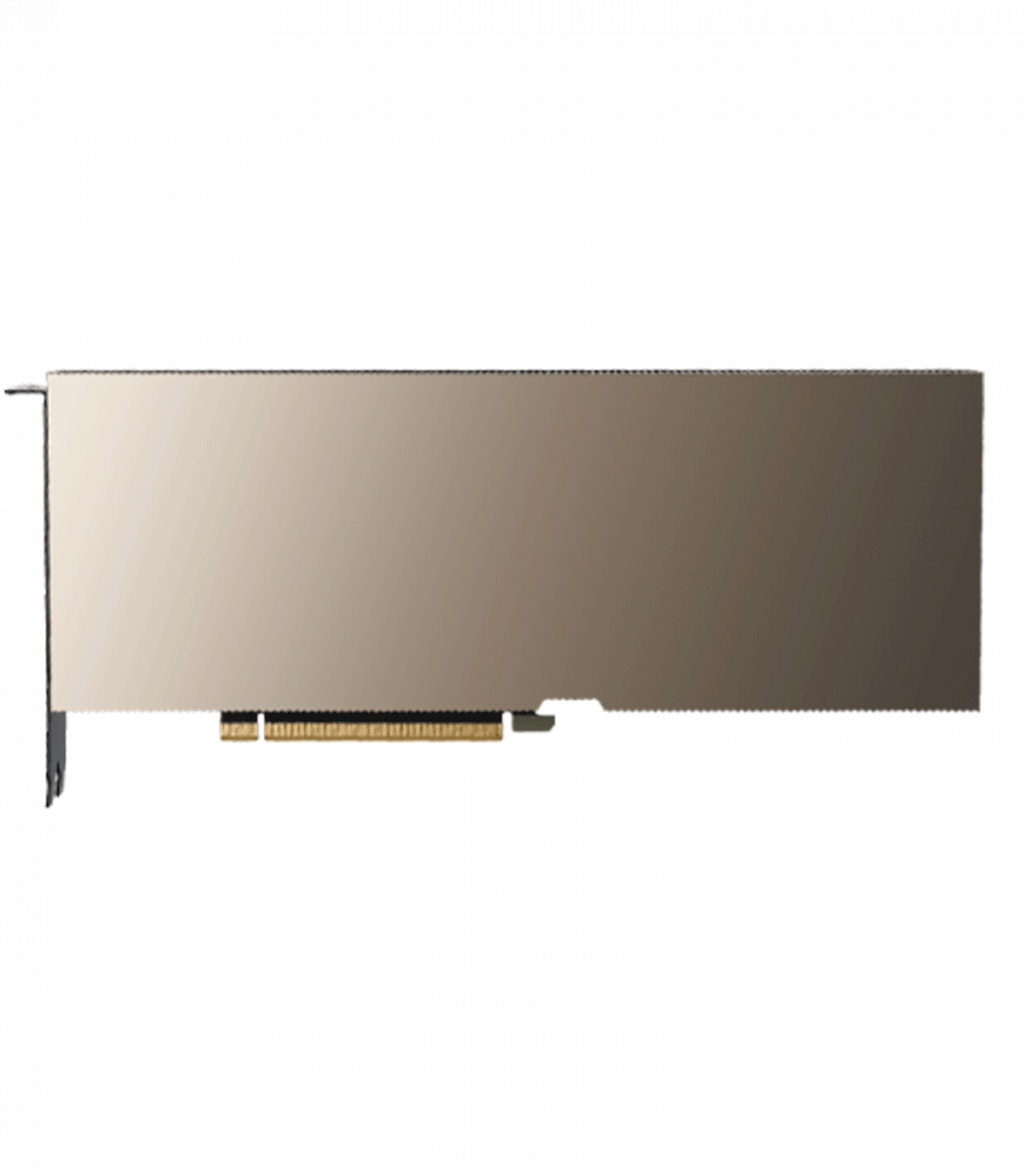
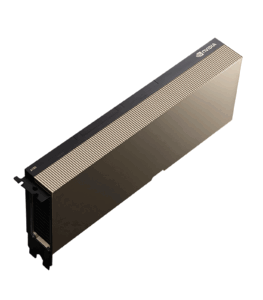
 The NVIDIA Ampere A100 Tensor Core GPU 80 GB PCIe 4.0 graphics card has set new benchmarks in high-performance computing, making it a revolutionary choice for industries and applications that require unparalleled computational power. Engineered for the modern data center, the A100 GPU comes with groundbreaking advancements in GPU architecture, making it ideal for complex data processing, machine learning, deep learning, and artificial intelligence (AI) workloads. This GPU offers a dual-slot form factor, making it suitable for powerful servers and workstations while being compatible with PCIe 4.0 to ensure high-speed data transfers. Below, are Graphic Card features, performance, and benefits of this GPU in detail.
Key Specifications and Design
The NVIDIA Ampere A100 Tensor Core GPU boasts a robust 80 GB of high-bandwidth memory (HBM2e), which allows for handling massive datasets essential for advanced computation. The memory is coupled with PCIe 4.0, offering twice the bandwidth of its predecessor, PCIe 3.0, ensuring faster data transfer between the GPU and the CPU. The dual-slot design makes it suitable for integration into larger servers and workstations, optimizing space and power usage for high-performance tasks.
The GPU leverages NVIDIA’s Ampere architecture, known for its enhanced performance compared to previous generations like Volta. The architecture is designed to deliver a significant leap in both throughput and computational capability, featuring advancements like multi-instance GPU (MIG) technology, which allows a single A100 GPU to be partitioned into up to seven separate GPU instances. This capability is particularly beneficial for businesses and data centers that need flexible resources to cater to multiple clients or workloads simultaneously.
Advanced Tensor Cores
One of the standout features of the NVIDIA Ampere A100 GPU is its third-generation Tensor Cores. These cores are specifically designed to accelerate AI and machine learning workloads, providing up to 20 times more performance compared to previous GPU generations. The Tensor Cores support a range of numerical formats, including TF32 (TensorFloat-32) and FP64 (double precision), allowing users to balance precision and performance based on their specific application needs. TF32 is especially beneficial for deep learning as it strikes a balance between performance and numerical accuracy, enabling faster training times without compromising on results.
The 80 GB version of the A100 ensures that large neural networks can be processed and trained more effectively, improving iteration times for data scientists and AI researchers. Whether it’s processing data for image recognition, natural language processing (NLP), or complex simulations, the A100’s Tensor Cores ensure that workloads are handled with remarkable speed and precision.
Scalability with Multi-Instance GPU (MIG)
The NVIDIA Ampere A100 Tensor Core GPU features Multi-Instance GPU (MIG) technology, an innovative approach that provides multiple GPU instances from a single A100 card. Each of these instances operates independently, with its own memory, cache, and compute cores, allowing organizations to maximize their investment by running multiple smaller workloads in parallel. This feature is crucial for shared environments like data centers or cloud-based services that need to cater to various user demands concurrently.
MIG technology allows for a better utilization rate, making it possible to run diverse workloads without affecting performance. This flexibility translates to cost efficiency, as businesses can allocate resources dynamically, ensuring that the GPU’s power is used effectively, whether for training deep learning models or processing data analytics tasks.
PCIe 4.0 for Enhanced Data Transfer
The PCIe 4.0 interface of the A100 GPU ensures faster data transfer rates between the GPU and other components in a computer. PCIe 4.0 provides double the bandwidth of PCIe 3.0, reducing latency and increasing data throughput, which is especially beneficial for applications requiring real-time data processing. This is crucial in sectors such as financial modeling, medical imaging, and AI research, where high-speed data transfer can significantly impact overall system performance.
High-Bandwidth Memory (HBM2e)
The 80 GB HBM2e memory in the A100 GPU allows for massive datasets to be stored and processed simultaneously. HBM2e stands for high-bandwidth memory, which is essential for tasks that require extensive data throughput, such as training deep learning algorithms with large-scale datasets or running complex simulations. The 80 GB capacity is a significant upgrade that supports larger and more intricate AI models, enabling seamless training and inference.
Computational Power for AI and HPC
The NVIDIA Ampere A100 GPU is specifically designed for high-performance computing (HPC) and artificial intelligence. The Ampere architecture delivers improved FP64 performance, making it a robust option for double-precision floating-point calculations, which are often required in scientific computing. The A100’s capabilities extend to tasks such as weather prediction models, protein folding simulations, and large-scale computational fluid dynamics (CFD). The GPU’s power efficiency, coupled with its computational capacity, makes it a go-to choice for institutions aiming to push the boundaries of research and development.
Applications in Various Industries
The NVIDIA Ampere A100 Tensor Core GPU is versatile and applicable across numerous industries. In healthcare, it is used for medical imaging and diagnostics, allowing for faster and more accurate interpretations of complex images such as MRIs and CT scans. In finance, the A100 supports risk analysis, fraud detection, and real-time trading models by processing large datasets with low latency.
The A100 GPU is also popular in the automotive industry, where it helps accelerate the development of autonomous vehicle technologies. By training AI models that process sensory data from cameras, LiDAR, and radar, the A100 contributes to the creation of safer and more efficient autonomous systems. Moreover, research facilities and universities leverage the A100 for advanced simulations and data analysis, supporting the exploration of new scientific theories and experiments.
Enhanced Security Features
 Security is a growing concern in modern networking and data processing. The NVIDIA Ampere A100 addresses this with robust security features that safeguard sensitive data during computation. Enhanced security protocols, combined with MIG technology, ensure that different workloads running on separate instances do not interfere with each other, protecting data integrity and preventing unauthorized access.
Energy Efficiency
Despite its impressive performance capabilities, the NVIDIA Ampere A100 Tensor Core GPU is designed with energy efficiency in mind. The Ampere architecture incorporates design features that optimize power consumption, making it suitable for data centers aiming to maintain performance while minimizing energy costs. This efficiency not only reduces operational expenses but also aligns with sustainable technology practices, contributing to the reduction of a facility’s carbon footprint.
The NVIDIA Ampere A100 Tensor Core GPU 80 GB PCIe 4.0 is an exceptional PC component that stands at the forefront of high-performance computing and AI development. With its extensive 80 GB of HBM2e memory, support for PCIe 4.0, advanced Tensor Cores, and MIG technology, it offers an unparalleled solution for complex data processing and multi-instance management. The A100 is ideal for industries ranging from healthcare and finance to automotive and scientific research, providing the computational power necessary for demanding applications. Whether you are located in UAE, Dubai, Sharjah, Ajman, or Abu Dhabi, integrating an NVIDIA Ampere A100 GPU into your server or workstation setup can dramatically elevate your networking and computational capabilities.